Matchbox Chest of Drawers

We’re not pyromaniacs, really. But we do manage to go through matches at an alarming rate. And I always squirrel away the matchboxes–like clementine crates, I find them impossible to toss. So I guess that makes me a pyromaniac and a hoarder.

After I wrote about dollhouse love last month, I remembered making this matchbox chest of drawers as a kid. For those of you who share my affection for little things, this Lilliputian project is fun & quick. I used 4 matchboxes, a piece of polka-dot card stock, and those doodads (not brads–snaps?–but brads would do the trick). Here is a downloadable pdf with step-by-step instructions for making your own mini dresser.

I also admired this groovy homemade dollhouse in the April issue of Family Fun magazine (“House & Carton” by Amy Brown). This Family Fun link shows you how to make your own (from two cardboard boxes) complete with the fancy furnishings (all fashioned from egg cartons).

House & Carton

(Photo by Andrew Greto; ideas and craft stylings by Lynn Zimmerman. Reprinted with permission of Disney FamilyFun. Copyright April 2011.)

And while I’m on the topic of the miniature (I know, I know–again!) . . . I thought I’d mention the three-book series, Doll People, by Ann M. Martin and Laura Godwin, with exceptional black-and-white illustrations by Brian Selznick (including a cut-away of an antique dollhouse).
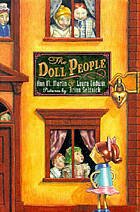
Yes, the doll people are alive & there’s a creepy baby doll in one of the stories–but the books are gentle and true to a kid’s perspective. They are emphatically not Toy Story. Toy Story 3, with its hints of torture and apocalypse, left my 5-year-old weeping in the theater aisle. And me, too, for that matter. But Zeke & I just finished these books & we loved them.
Dollhouse Love

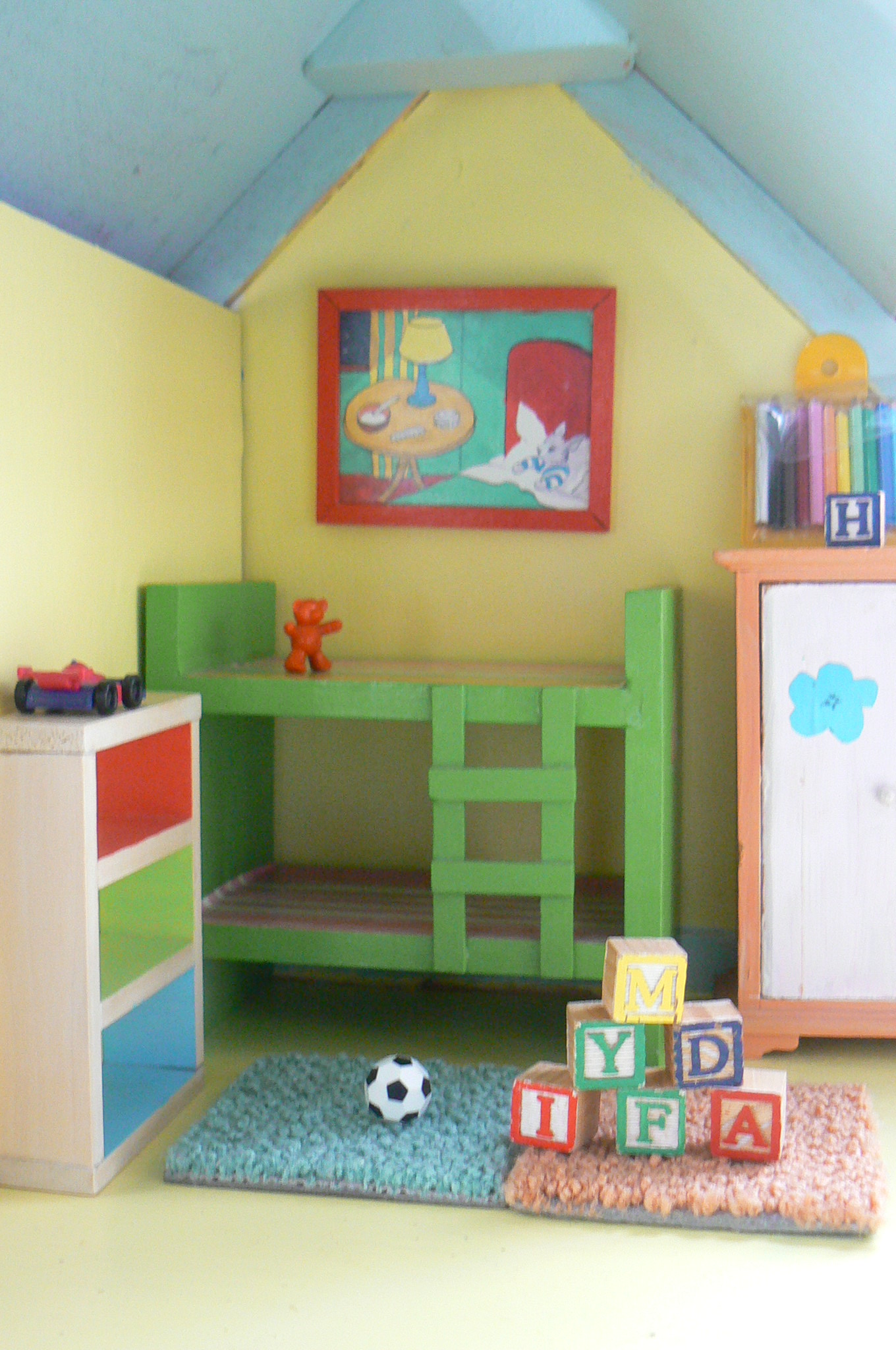
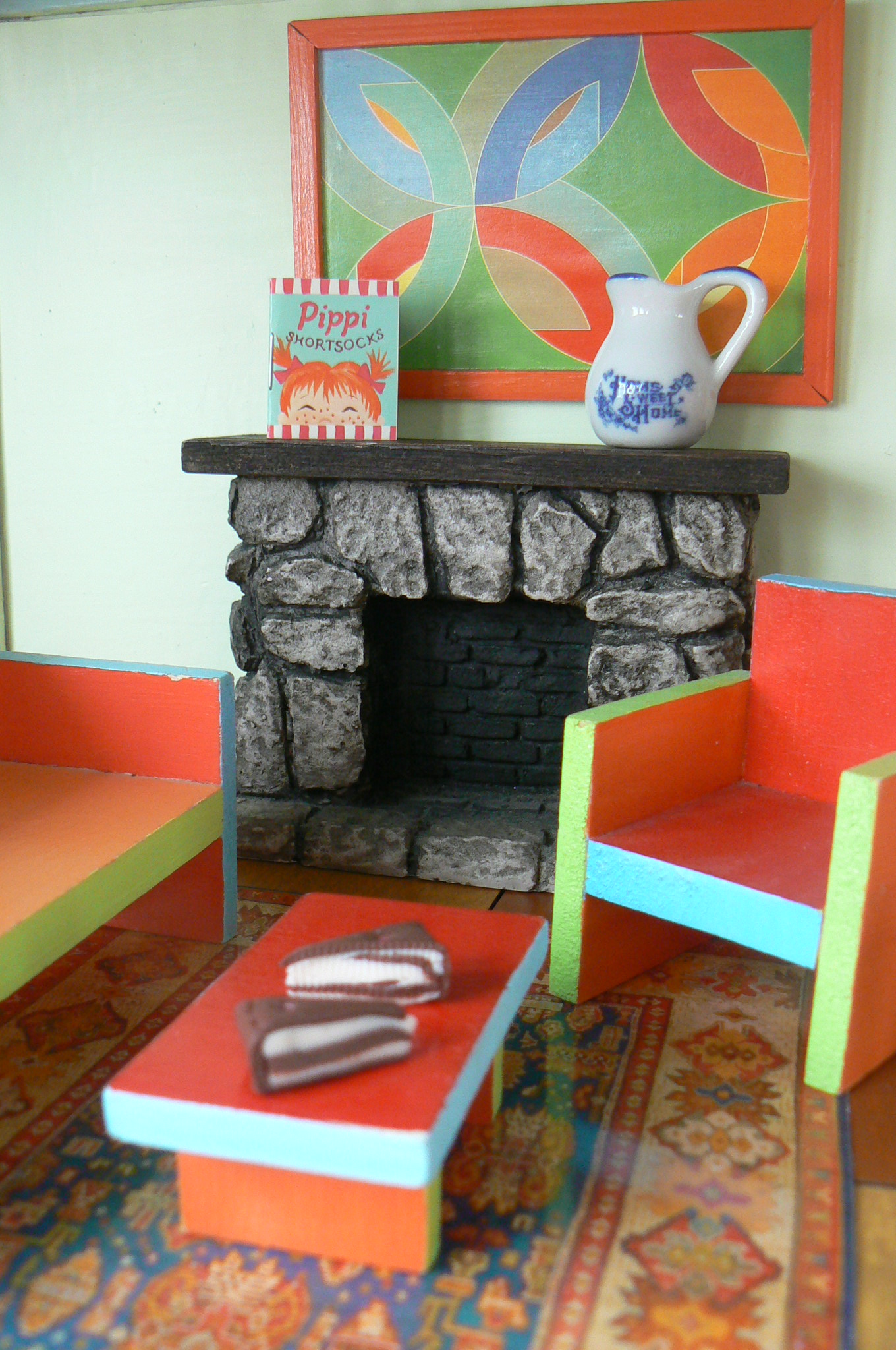
Abe was indifferent. Zeke was a step up from that–fond? bemused?–whatever implies a distant affection. It was clear: neither of my kids toppled head over heels in love with the dollhouse I rescued from the curb, took home and painted, papered, and decorated with homemade furniture and–get this–a miniature Frank Stella.

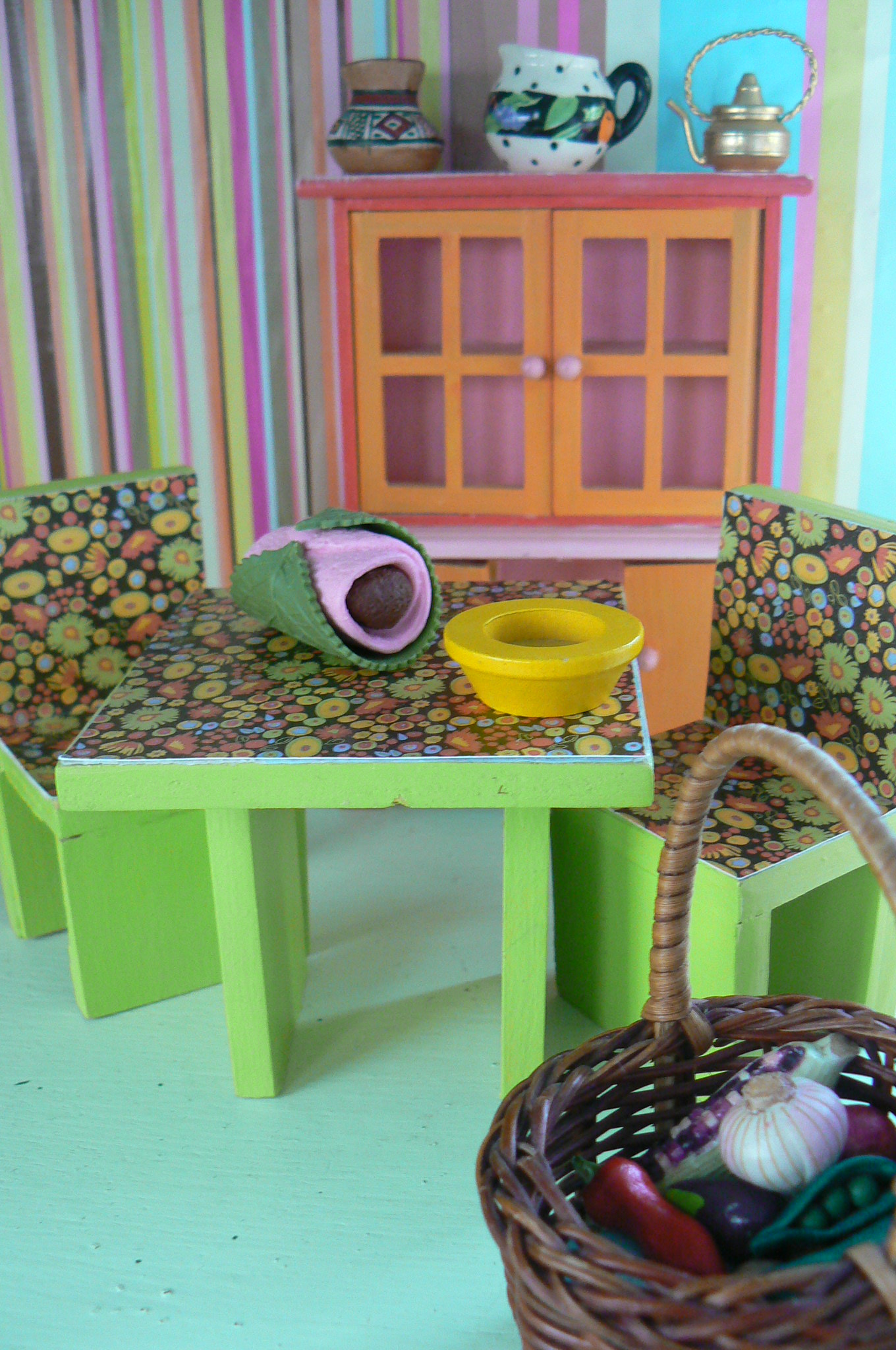
I mean, I went through a lot of (happy) trouble working on that thing. To make the Lilliputian furniture, I drew up little elaborate blueprints. My husband then took the plans to his architecture firm and asked the model shop to cut the pieces to size. (Did the model shoppers ever figure out the identity of the “client”? Was it, in fact, completely obvious?)

I sewed tiny pillows & stitched mini felt blankets. I made side tables out of those plastic thing-a-ma-bobs that come in the middle of pizzas. Bunk beds. Books as big as postage stamps. A bath mat the size of a match box.

My family (and the model shoppers) humored my obsession with the small scale. They regarded me with polite–and always kind–detachment. But in the ten years since, I’ve learned something important:

Sometimes, it takes a village to love a dollhouse.

First it was Sophia Alvarez, my seven-year-old neighbor. When she wasn’t constructing a Playmobil megalopolis in her bedroom, she’d come over and rearrange the dollhouse furniture for me. Over the years came other caretakers–Addie, Lila K., Lila M., Sophie U., Sophie B., Mary, Danny, Norman, and every teenage babysitter I have ever hired. It ends up I’m not the only one who appreciates the little things of life.

So if you’re with me, make sure to check out these shrunken exemplars of pristine Modernism in a NYT slide show.

(Photo by Robert Presutti for the New York Times)

Or creep yourself out with this slideshow of shoebox crime scenes beautifully photographed by Corinne May Botz in The Nutshell Studies of Unexplained Death.

The Nutshell Studies of Unexplained Death

Or admire this 23-room, 5-story house made by Faith Bradford, in this online tour. You can also see it in person at the National Museum of American History in D.C. (And yes, I was just in Washington for school vacation week. Guess what? No one in my family wanted to go see Faith’s dollhouse with me. Sigh.)

America's Doll House: The Miniature World of Faith Bradford

Origami and Quilts for Japan

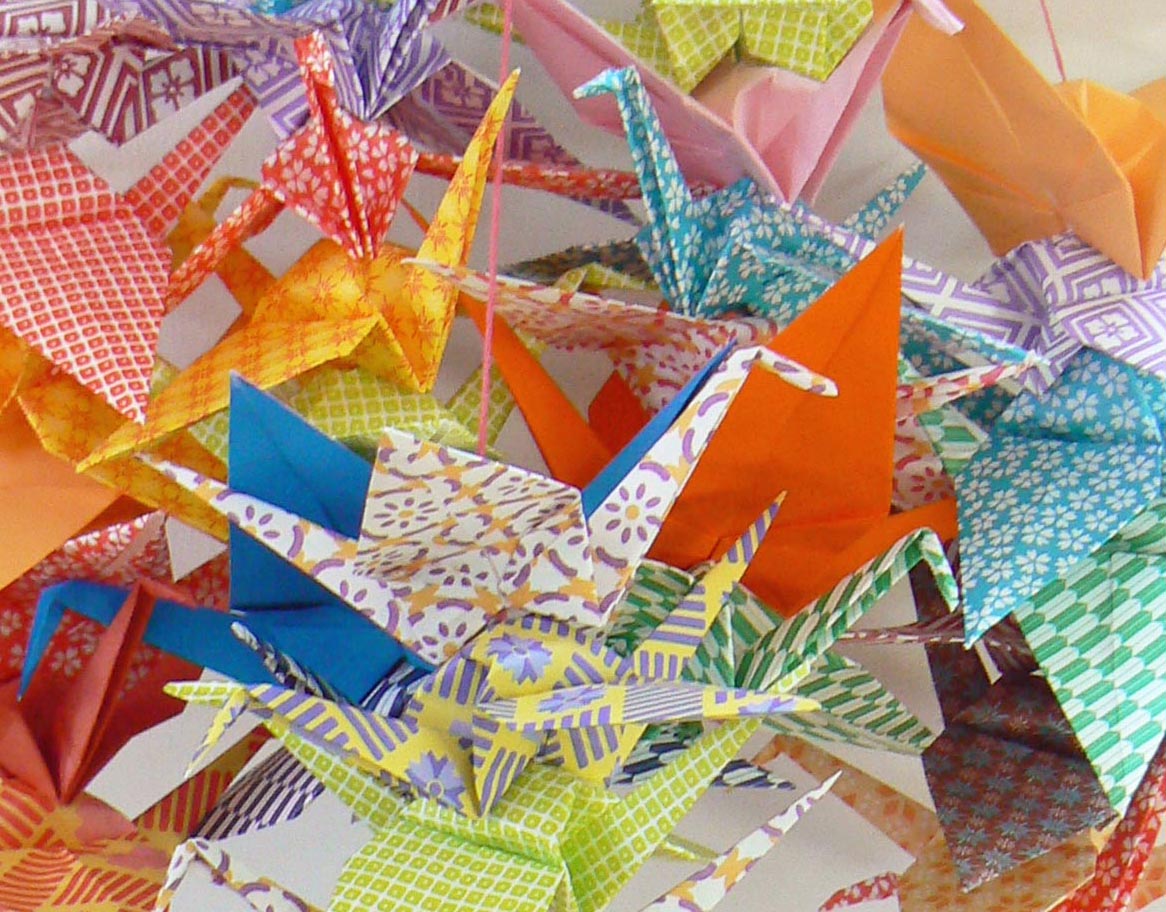
This is what I’ve been up to this week: folding paper! Specifically, cranes–for a “1,000 crane” fundraiser at my son Zeke’s preschool for those affected by the recent earthquake in Japan.

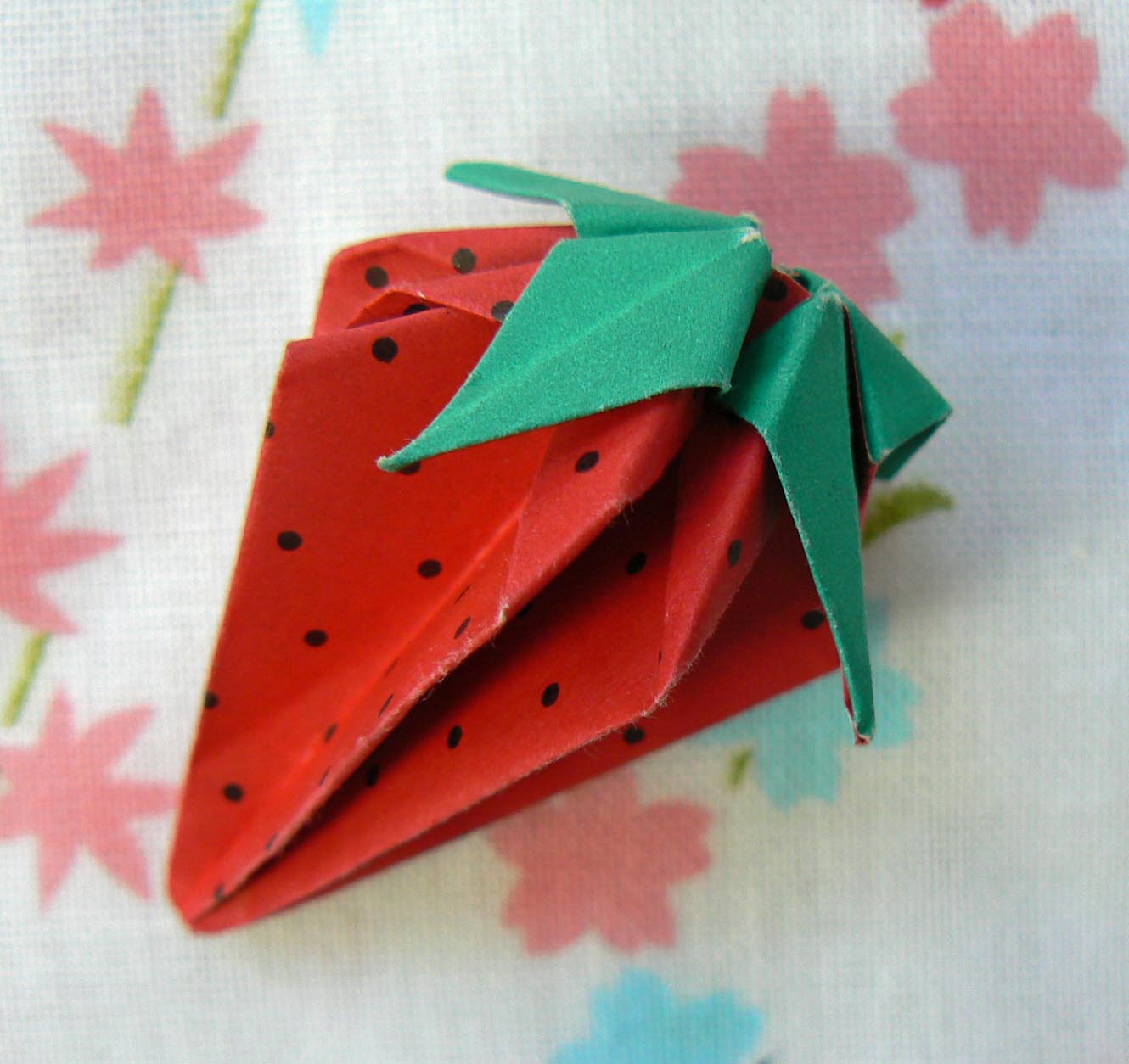
Maybe you are making origami strawberries (like this one we bought at another Japan fundraiser at Abe’s elementary school)  

or contributing in another way, but if you are a quilter, Gather Here, the fabric store/stitch lounge at 370 Broadway in Cambridge is offering a couple of novel ways to join the effort for Japan:

  • Stock up on your favorite Japanese fabrics (including Kokka, Echino, Kiyohara) and the store will donate 25% of your purchase to Red Cross.
  •  Join Gather Here’s quilter’s bee for Japan, the last meeting of which is this Sunday, April 17, from 4 to 6 p.m. at the shop. (Oh, and if you do read this post by Virginia: I am not the “very nice lady” named Margaret that she mentions. I am definitely another Margaret.)

Virginia also posted about an effort by Quilter’s Newsletter to gather quilts from Amerian quilters for those in need in Japan. If you have a quilt (any size, baby to adult) you’d like to send, the information is here. The deadline is April 30.

One-Hour Pillow and Other (Small) Adventures

I curbed my craftiest ambitions this week after one of the fabric-painted robot tees that I made last week emerged from the washer: a smudged, sorry schmatte. What happened? I swear I followed directions (I think). And still here is this mottled t-shirt-now-dust rag. Tragedy. Or at least, very minor disappointment.  

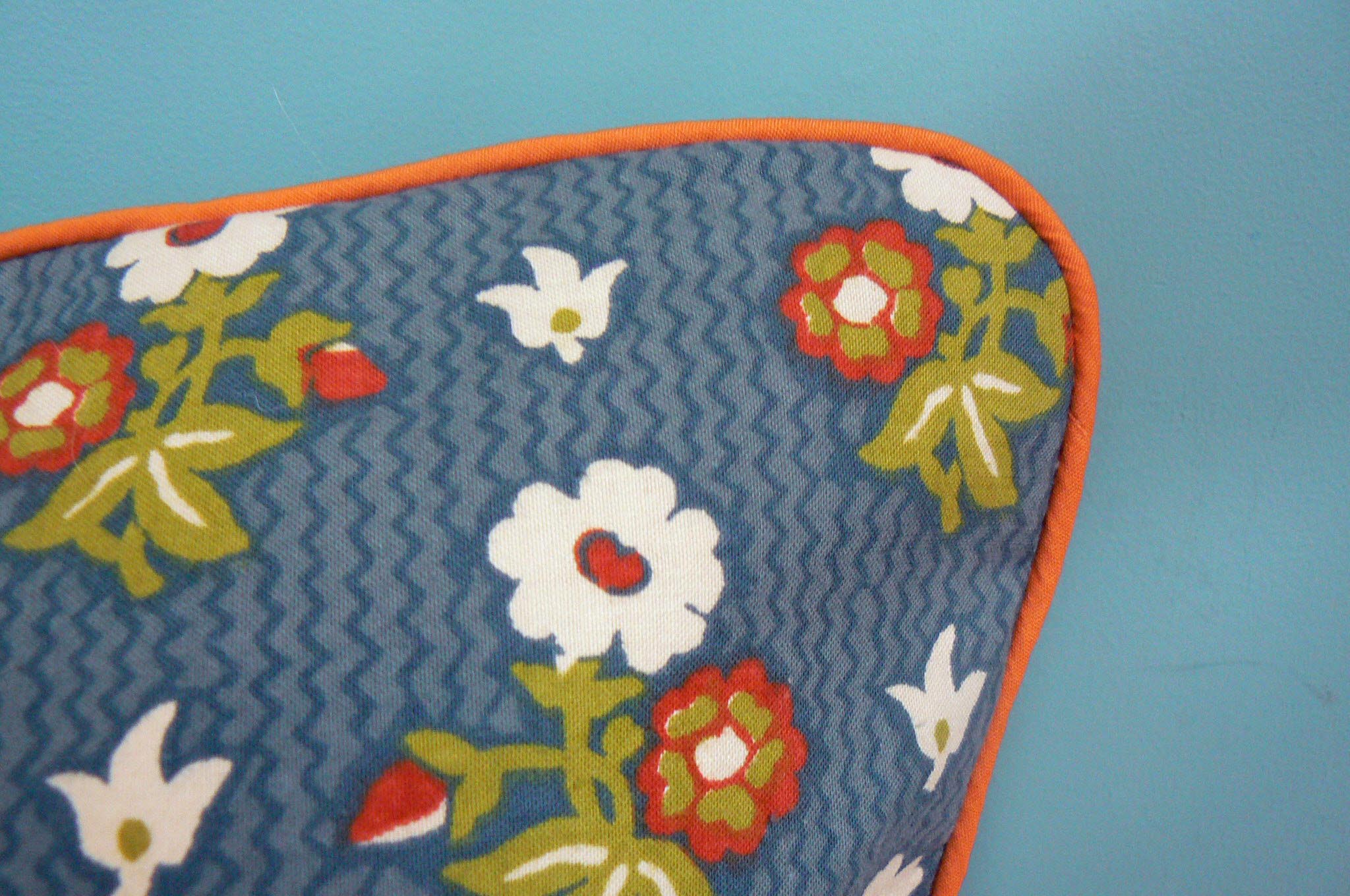
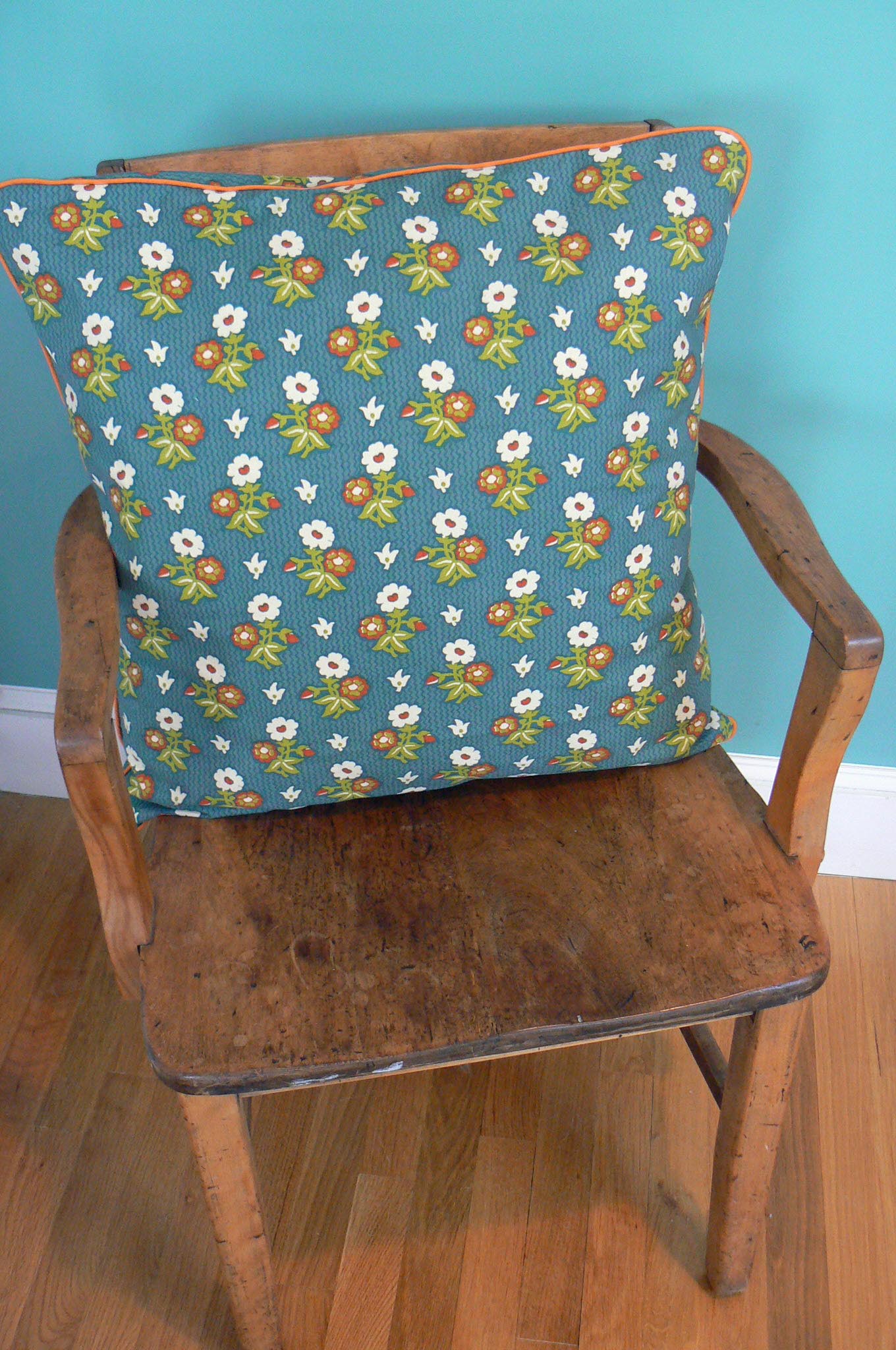
Moving on: I’ve been meaning to make a pillow cover with some of this flower print I bought at a yard sale. I had a 22 x 22″ pillow insert, low goals, and about one hour, so I stuck with an envelope-style enclosure. I (more or less) followed the instructions at Cottage Magpie, which I thought were very good with excellent, helpful photos. I’m actually really proud of the piping (which I bought pre-made–so why the pride?). But the piping was fun to sew (zipper foot!) and it gives the pillow its essential pillowness, I think.

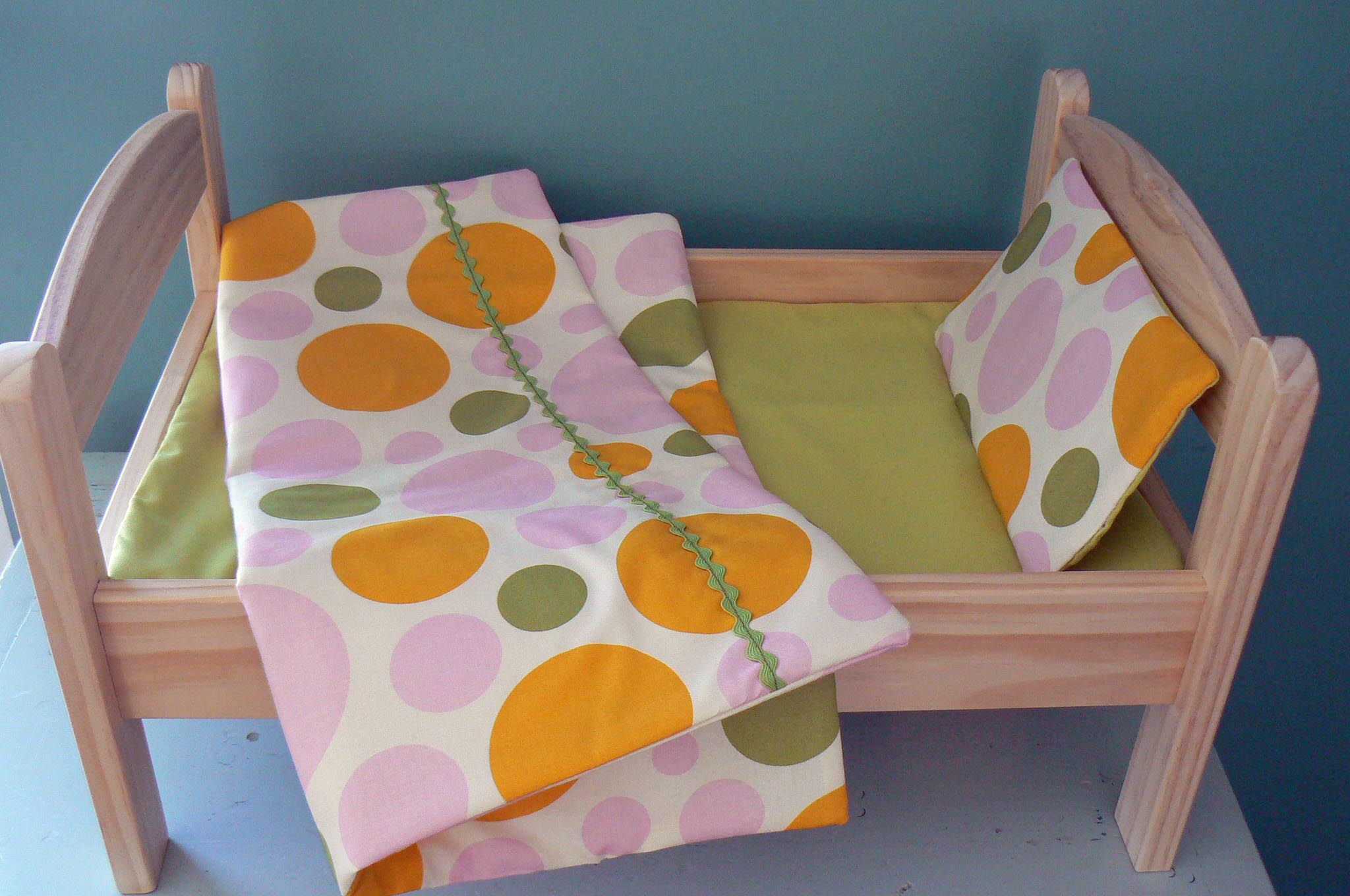
My other small adventure: sewing covers for the ugly blue mattress and pillow that came with the IKEA doll bed I bought for my neice and nephew. (Why does IKEA favor retina-searing shades of blue?) I also sewed a doll blanket to go on top. (For Boston locals: I bought the big polka-dot print from Fabric Corner, a sewing shop on the corner of Mass Ave. & Mill Street in Arlington, which has a lovely fabric selection & kind, friendly staff.) Following Brigit’s doll quilt post, I just sewed regular seams and turned inside out (although I added a layer of quilt batting and didn’t do the quilter’s knots).


But my biggest–and tiniest–achievement of the week? Figuring out how to do that tricky little stitch to close up seams. The stitch is sometimes called an invisible stitch, which makes it impossible to visualize, right? Whereas when the stitch is called a ladder stitch (visual here), it loses all its terrible mystery and becomes possible, and really not that hard.

Freezer Paper Stencils: VW Bus Pillowcases

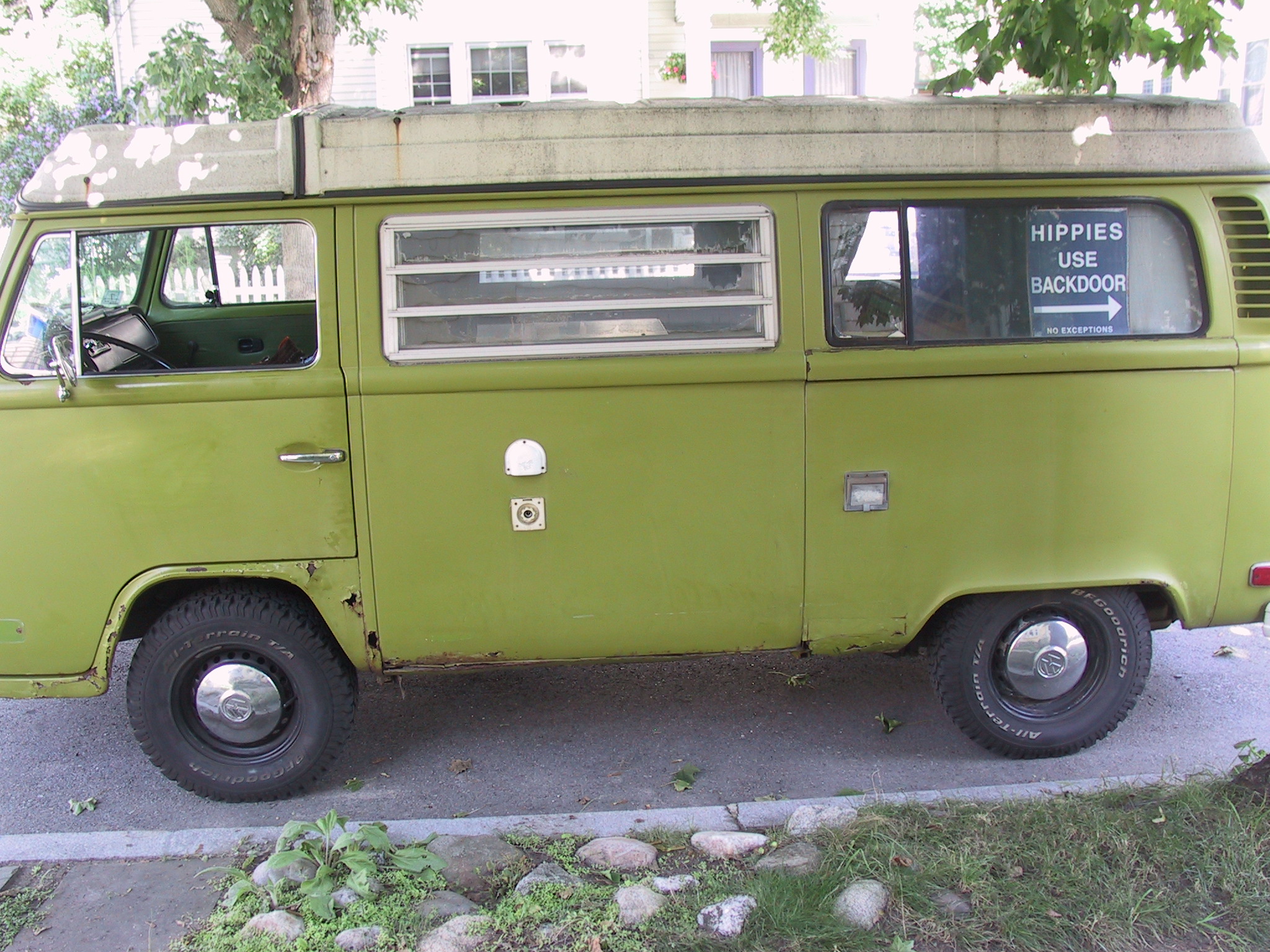
Punch buggy. (Or in this case, Punch bus.) Spring is here & so is the VW bus parked outside my house. (The sign in the window says: Hippies Use Backdoor.)

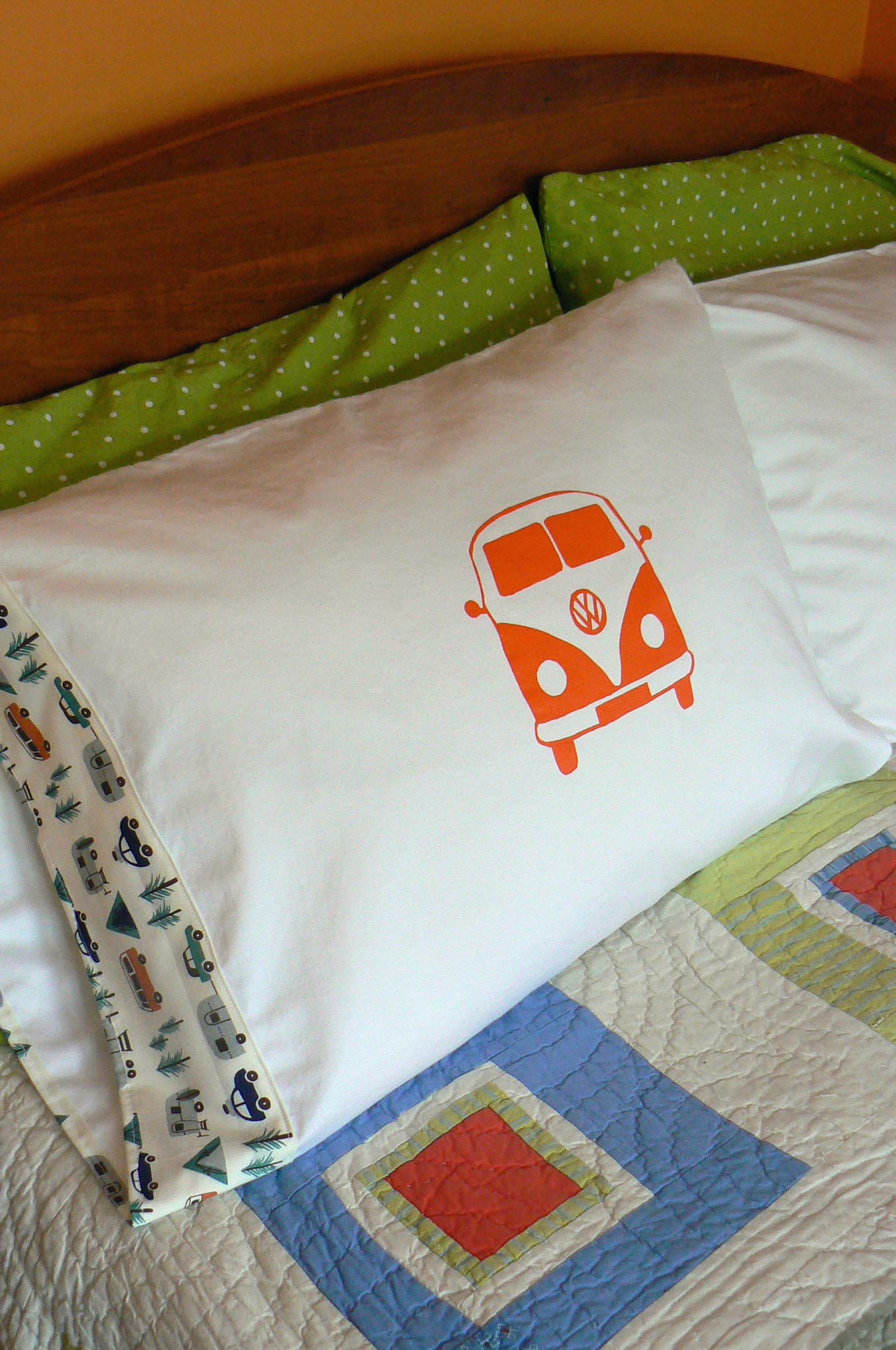
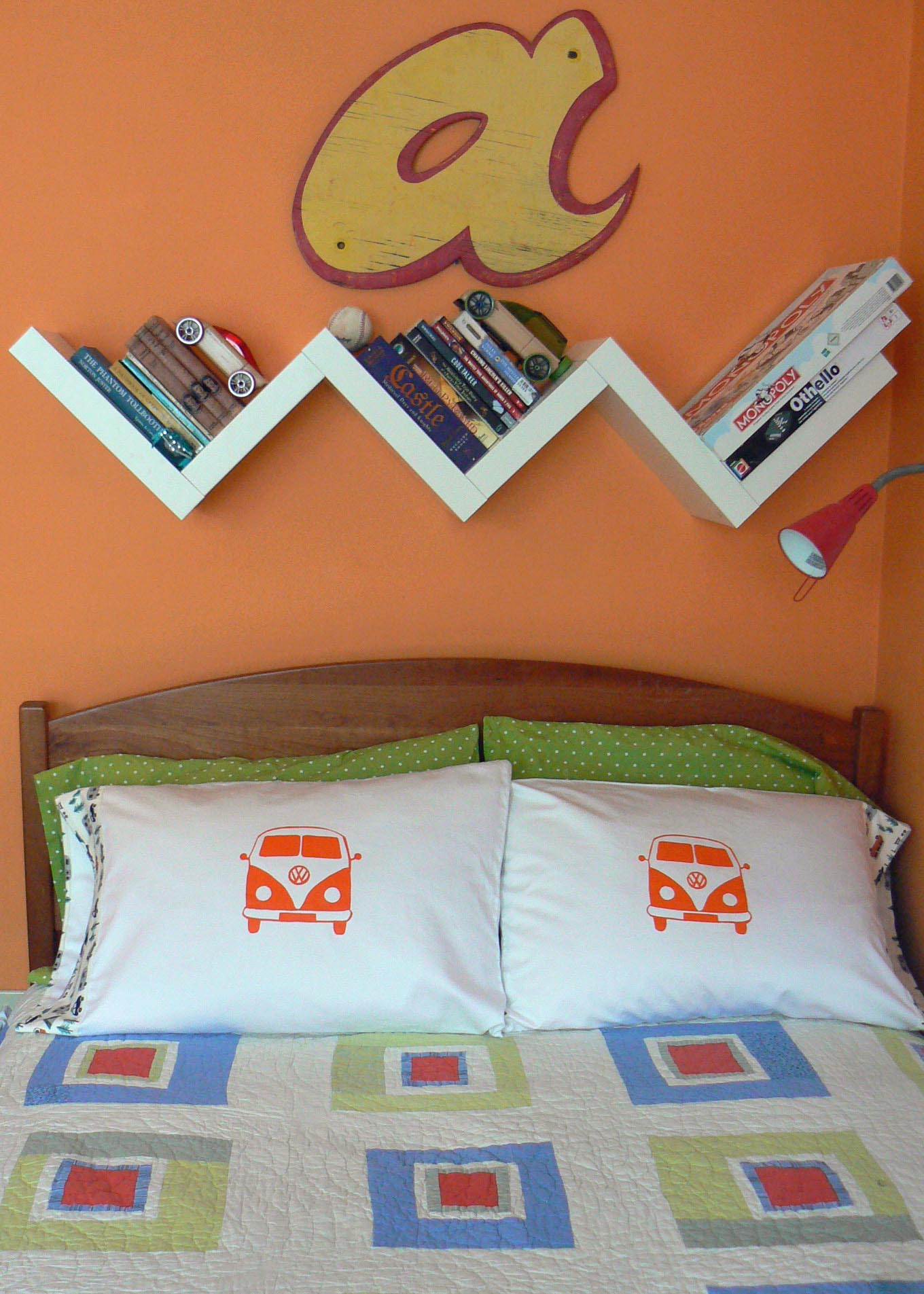
So in honor of the reappearance of spring and VW buses, I decided to give some old white pillowcases new life. Plus I wanted to make something for my 11-year-old who is easily embarrassed by T-shirts proclaiming anything, let alone T-shirts homemade by his mother, so I figured pillowcases were a safe zone, free from 5th grade peer review.

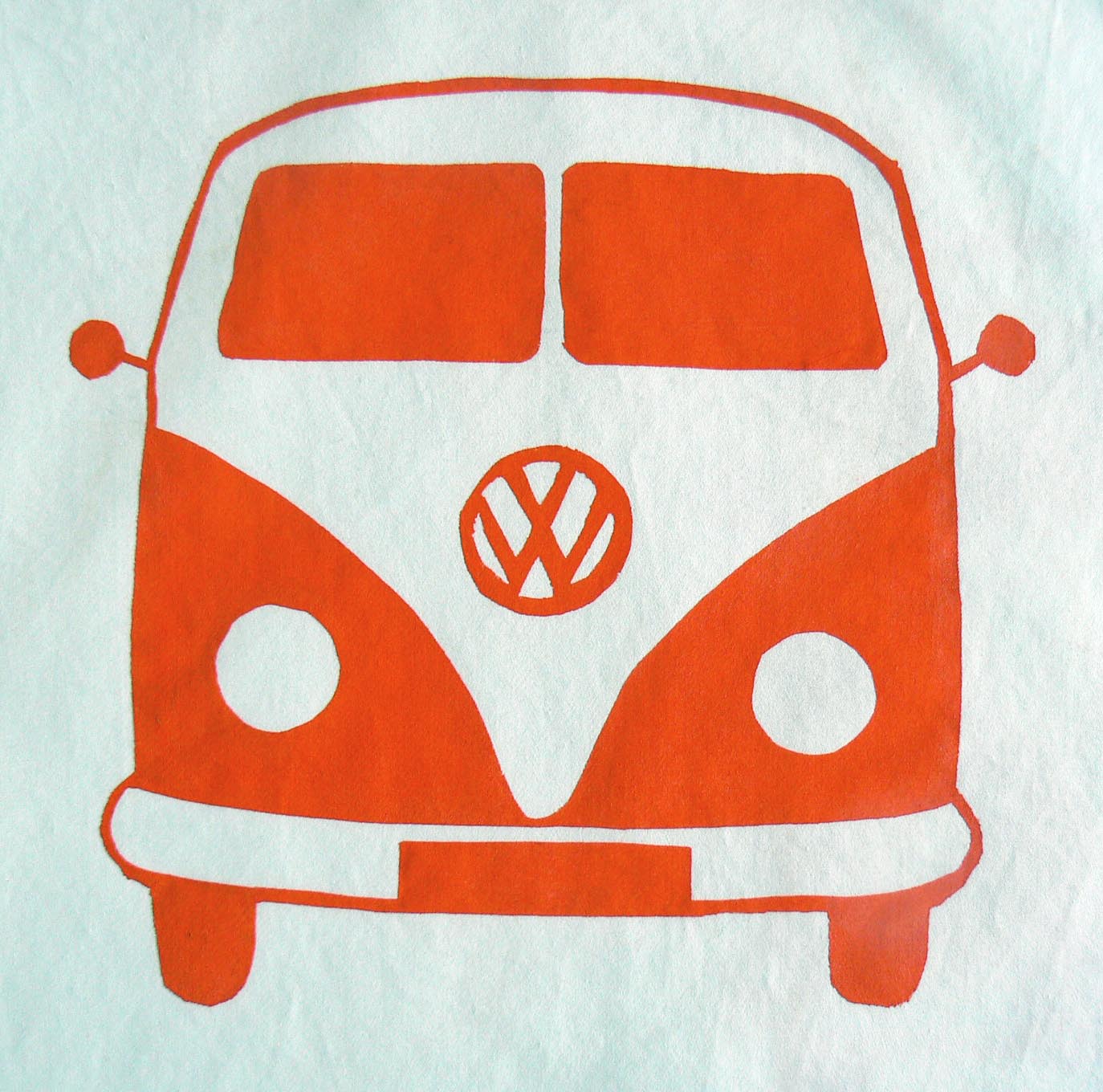
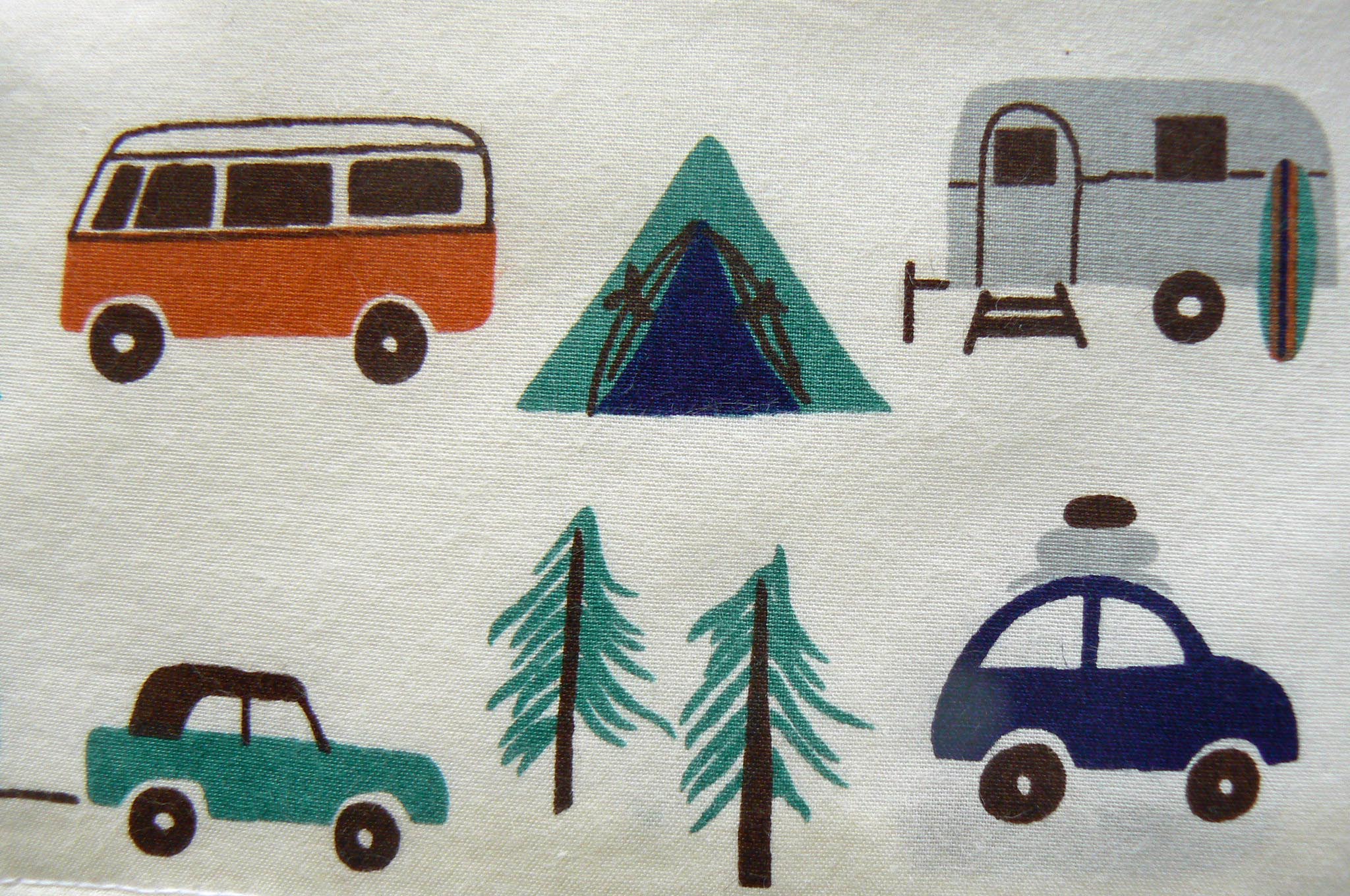
I cut a stencil on freezer paper from an image of a VW bus that I downloaded online. As I’ve mentioned before, freezer paper stencils are wicked easy & satisfying. Here is the complete how-to. To trim the pillowcases, I bought a half a yard of Happy Camper fabric from the Monaluna Circa 60 Beach Mod line for Birch Fabrics (available at Fabricworm). I should’ve bought a yard, but I was too cheap ($8.25 for half a yard!). It’s organic, alas.

 (The print is darker than how it appears on Fabricworm.)

No room for error. The pressure was on! I sewed the fabric directly onto the existing pillow trim (I split the seam for the trim–but not the rest of the pillowcase–to make it easier to sew). For the edge that you see on the outside of the pillowcase, I folded 1/4″ of the fabric, ironed, and sewed as close to the edge as I could. For the hem inside of the pillowcase, I folded 1/4″ over twice to completely encase the raw edge. Not sure if this is the best way to add trim, but it looks decent and adds a pleasing weight to the end of the pillow.